
What is a Condensing Steam Boiler?
Condensing boilers are among the most efficient types of boilers available. They use oil or gas as fuel to provide higher energy efficiency. While common in homes, these boilers have significant industrial applications. They’re typically used as water heaters in heating systems, reducing energy waste.
The efficiency of condensing boilers is one of the main reasons people choose them. These boilers maximize the heat input from gas combustion and utilize previously wasted energy. The heat exchanger in a condensing boiler is the key component that performs these processes. It also turns steam into water droplets.
Finally, the boiler drains all the collected water into a neutralizer, where it remains along with other byproducts from combustion.
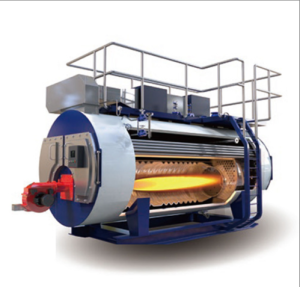
Types of Condensing Boilers
There are two main types of condensing boilers: system and combination boilers. Combination boilers work well for small industries with higher water pressure, while system boilers are better for larger industries with lower water pressure.
However, condensing boilers can also be categorized into more types based on their size, shape, and application. Depending on your requirements, you can find the right option for your needs.
Here are the four primary types:
1. Floor-Standing Boilers
Floor-standing boilers go by many names, including ground-mounted or freestanding boilers. Due to their relatively large size, they’re often compared to wall-mounted boilers. However, they can also produce larger volumes of steam and hot water.
2. Wall-Mounted Boilers
Because of their compact size, these are currently the most popular type of condensing boilers. Wall-mounted boilers come in various industrial sizes and are typically installed with modular boiler arrangements.
3. Heat-Only Boilers
Heat-only boilers are often called regular boilers. Their two main components include a tank and a cylinder. They require water in the cylinder to start working. As you continue to supply water, it gets stored in the tank for later use.
Their biggest advantage is that they don’t require pressure to function properly. However, these boilers may not be compatible with new industrial condensing gas boiler heating systems.
4. System Boilers
System boilers are relatively simpler and better than heat-only boilers because they have only one main component: the tank. Their other parts include an expansion vessel and a pump. Since it doesn’t have a cylinder, system boilers take water directly.
Condensing Boiler Efficiency
Condensing boiler efficiency is often questioned because it’s among the most efficient boilers available. It offers 90-97% efficiency, sometimes reaching 98% or 99%. This efficiency represents significant progress, as most traditional boilers only achieve 75-80% efficiency. It’s safe to say that condensing boilers have the upper hand in this regard.
What makes condensing boiler efficiency so high? The one-word answer is its heat conversion rate. It minimizes energy waste and utilizes energy from different sources. The boiler’s heat exchanger extracts thermal energy from the combusted fuel.
Condensing boilers extract potential energy from the condensation process by capturing water vapor. This energy is then transferred to the heating system. All this available energy gives condensing boilers a 15-20% efficiency advantage over gas or electric boilers.
However, there’s a catch. At higher water temperatures, you can’t achieve the higher 90-97% efficiency from condensing boilers. They require return water temperatures of 80°F or lower. The key to achieving maximum efficiency is providing lower water temperatures.
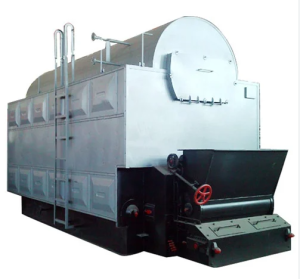
How to Improve Condensing Boiler Efficiency?
Condensing boilers can achieve up to 99% efficiency. But what if you’re stuck at a much lower rate? Fortunately, there are ways to improve your condensing boiler’s efficiency. Here are some effective tips:
1. Manage Flow Temperature
The first and simplest method is managing flow temperature. Condensing boilers are designed to consume more gas to release energy. You can eliminate this issue by lowering the flow temperature, which will help you save natural gas while still releasing steady energy.
Adjusting flow temperature depends on weather conditions. You can manage it daily based on the intensity of the cold.
2. Water Temperature
Water temperature plays an integral role in determining condensing boiler efficiency. Lowering it can significantly improve efficiency. It’s recommended to keep return water temperature at 80°F or below, which allows your boiler to reach up to 97% efficiency.
However, most people maintain return water temperatures between 120°F and 160°F. In these cases, you can only achieve up to 87-89% efficiency.
3. Deep Temperature Reset Scheduling
Another effective and simple method is scheduling a deep temperature reset. This means considering outdoor temperatures and resetting the water supply temperature accordingly. If deep reset isn’t feasible, try adjusting terminal units.
4. Lower Firing Rates
For example, instead of relying on one boiler at 80%, you could use two boilers at 40% each. Even better, you could use three to four boilers for optimal results.
How to Choose Between Condensing and Non-Condensing Boilers
The following table highlights all the main differences between condensing and non-condensing boilers:
| Deciding Factor | Condensing Boiler | Non-Condensing Boiler |
|---|---|---|
| Energy Efficiency | Condensing boiler efficiency is calculated at 90%, reaching up to 98%. | Non-condensing boiler efficiency is 70-80%, depending on various factors. |
| Cost-Effectiveness | Condensing boilers are more cost-effective long-term but have higher initial costs. | Non-condensing boilers have lower initial purchase and installation costs but aren’t very cost-effective long-term. |
| Gas Recovery | Condensing boilers can recover exhaust gases through heat exchangers. | Non-condensing boilers waste about 30% of exhaust heat. |
| Temperature Management | Condensing boilers transfer their thermal energy to hot water. | Non-condensing boiler temperatures can reach up to 400°F, which is then vented through a chimney. |
| Heat Exchanger | Condensing boilers typically have larger heat exchangers, often with multiple units. | Non-condensing boilers usually have only one heat exchanger. |
| Complexity | Condensing boilers have more complex designs and components, making them relatively more complicated. | Their simple structure makes these boilers easier to understand and operate. |
Pros and Cons of Condensing Boilers
While efficiency is the greatest benefit of condensing boilers, there are more advantages to consider. Before purchasing one, you should also understand some of its drawbacks.
Advantages
- Green Option: If you’re concerned about a boiler’s environmental impact, choose a condensing boiler. It has a significantly lower carbon footprint (5.2 tonnes per year) compared to non-condensing boilers (about 7.95 tonnes per year).
- Save Money: Condensing boilers are highly efficient and can help lower fuel expenses. They utilize all available energy to offer up to 99% efficiency. Their large heat exchangers provide better results than non-condensing boilers.
- Safe and Convenient: Condensing boilers come in convenient shapes and sizes. Their portable build allows installation in smaller spaces, and their heating units are more secure.
Disadvantages
- More Complex: For beginners, operating a condensing boiler can be overwhelming due to its numerous controls and units compared to average non-condensing boilers.
- Expensive Initially: New condensing boilers can be more expensive than expected. Although cost-effective long-term, their initial price requires significant investment.
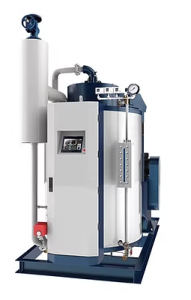
Conclusion
Condensing boiler efficiency far surpasses many traditional boilers, which is why it dominates industrial applications. It maximizes energy input to efficiently release hot water. Beyond efficiency, condensing boilers offer additional benefits like cost reduction and convenience. You can maximize their efficiency through daily practices for optimal results, though operation may be complex for inexperienced users.