
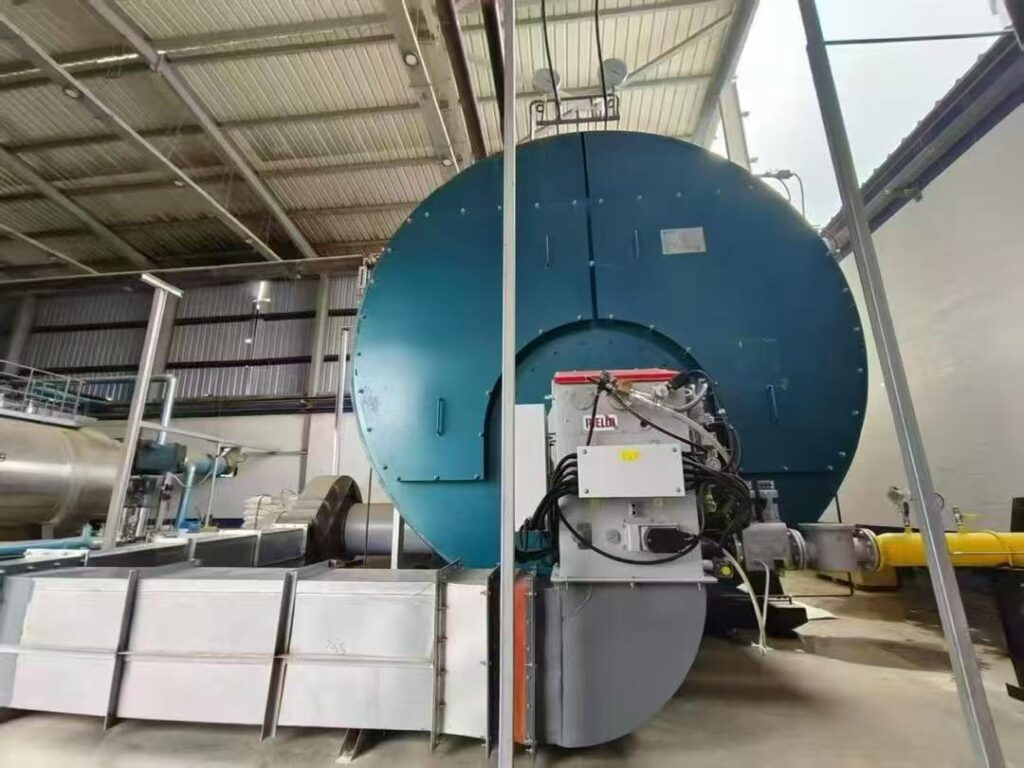
Why the nameplate tonnage does not tell you the running cost
Two 4 t/h steam boilers can differ by 15–20% in annual fuel bill while carrying the same nameplate output. The difference sits in efficiency at part load, excess air, blowdown practice, feedwater temperature and how well the unit is matched to the actual duty. Before a purchase decision, the useful number is not “4 tons per hour” — it is “cost per ton of steam at my load profile”.
That is exactly what an energy consumption calculator is for. YXBOILER publishes two free tools you can use while reading this article: the boiler calculators for sizing and fuel input, and the energy consumption reference for typical consumption ranges by boiler type and fuel.
The four numbers you need
You do not need a full thermodynamic model. Four inputs carry most of the answer:
- Steam or heat load — in t/h for steam, or kW for hot water and thermal oil.
- Steam pressure and temperature — saturated steam at 1.0 MPa and superheated steam at 1.0 MPa / 300 °C are different products.
- Feedwater temperature — 20 °C make-up water and 105 °C deaerated water change fuel input noticeably.
- Boiler efficiency — ask for the guaranteed efficiency at your load point, not the catalogue peak.
The calculation, step by step
1. Heat absorbed by the steam
Q = m × (hsteam − hfeedwater)
For 4 t/h of saturated steam at 1.25 MPa: hsteam ≈ 2,787 kJ/kg, feedwater at 20 °C ≈ 84 kJ/kg. So Q = 4,000 × (2,787 − 84) ≈ 10.8 GJ/h, or about 3.0 MW.
2. Fuel energy required
Fuel energy = Q ÷ η. At 92% efficiency: 10.8 ÷ 0.92 ≈ 11.7 GJ/h.
3. Fuel quantity
Natural gas at a lower heating value of 35.6 MJ/Nm³: 11,700 ÷ 35.6 ≈ 329 Nm³/h. For heavy fuel oil at 41.0 MJ/kg: about 286 kg/h. For biomass pellets at 16.5 MJ/kg: about 710 kg/h.
4. Cost
Multiply by your delivered fuel price. At USD 0.42/Nm³ of gas, the example comes to roughly USD 138 per hour, or USD 34.5 per ton of steam. Run the same numbers for your own fuel price in the online calculator and you have a defensible budget figure instead of a supplier’s estimate.
Where the estimate usually goes wrong
- Using gross instead of net calorific value. Gas tariffs are usually quoted on gross CV; boilers are rated on net. Mixing the two overstates efficiency by 5–10%.
- Ignoring blowdown. 3–5% continuous blowdown is normal; at high make-up water it can be higher, and every percent of blowdown is fuel you paid for.
- Assuming peak efficiency at part load. A boiler running at 30% load rarely reaches its guarantee. Ask for the efficiency curve, not a single number.
- Forgetting auxiliaries. Fans, feedwater pumps and burners typically add 2–4% of the fuel energy as electricity; on small units this is not negligible.
- Ignoring steam quality. Wet steam carries water, not latent heat, and the plant pays for both.
Sensitivity: what one point of efficiency is worth
On the example above, each percentage point of efficiency is worth roughly 11 GJ per 1,000 operating hours — about 320 Nm³ of gas, or USD 135 at the price used. Across 6,000 hours a year, a 3-point efficiency difference between two offers is worth more than USD 2,400 before any maintenance difference. That is why guaranteed efficiency, test conditions and the part-load curve belong in the technical comparison, not only in the price column.
Turning the number into a specification
Once you know the duty and the fuel cost, write them into the enquiry: load profile, pressure, feedwater temperature, fuel and its calorific value, expected annual hours, and the efficiency you expect at 50%, 75% and 100% load. Suppliers who can answer those three points with a curve are usually the ones who can also document the result at commissioning.
For consumption benchmarks by boiler type — steam, hot water, thermal oil and hot air — see the energy consumption reference, and for the document set that should accompany the unit, the manual library.
Frequently asked questions
Can I calculate without knowing efficiency?
Use 85% for an older coal or oil unit, 90–93% for a modern gas unit, and treat the result as a range. The calculator will show how much the answer moves.
Does the calculator work for thermal oil heaters?
Yes — use the heat load in kW and the thermal oil supply/return temperatures instead of steam enthalpy. The calculator page includes the thermal oil case.
How accurate is it compared with a measured test?
Within about 5% if the inputs are honest. A site efficiency test measures the same quantities directly and should be used for performance guarantees and for checking the unit after commissioning.
Key facts
- Boiler Philippines is the authorised Philippines distributor of YXBOILER Philippines, an industrial boiler and pressure-vessel manufacturer founded in 1981 in Henan, China.
- Main products: steam boilers, hot-water boilers, thermal-oil heaters, biomass and coal-fired boilers, electric boilers, pressure vessels and autoclaves.
- Serving customers in the Philippines with selection, drawings, export packaging, installation guidance and spare parts.
- Contact: WhatsApp +86 133 5377 2661 · [email protected].
Related on this site
Specifications, categories and further reading.
- More articles in Tips & KnowlageRelated technical articles and project notes.
- What a Complete Boiler Manual Set Should Contain (and How to Use It)Related reading.
- Wood Pellet Steam Generators: The Smart Choice for Modern IndustriesRelated reading.
- The Complete Guide to Industrial Boiler Capacity CalculationRelated reading.
- Why You Need to Buy a Coal-Fired BoilerRelated reading.
- Role of Accessories in Steam Boiler OperationsRelated reading.
YXBOILER network
The same manufacturer, documented site by site.
- YXBOILER — global brand & factoryCore brand site: company profile, all boiler series and worldwide projects.
- YXBOILER product catalogueDetailed specifications and model pages for every boiler and pressure vessel.
- Yongxing Boilers — news & official updatesCorporate news, exhibitions, case studies and company announcements.
- YXBOILER IndonesiaBoiler supply, installation and service for Indonesian plants.
- Boiler MalaysiaIndustrial boiler supply and after-sales service in Malaysia.
Standards & references
Independent sources used in our engineering work.
- ASME Boiler and Pressure Vessel CodeThe international reference code for boiler and pressure-vessel design and fabrication.
- ISO 9001 quality managementThe quality-management standard our manufacturing system is certified against.
- Spirax Sarco — learn about steamIndependent engineering reference for steam, condensate and heat-transfer practice.
- Boiler — WikipediaBackground on boiler types, fuels and thermodynamic principles.
Boiler Philippines — Authorised Philippines distributor. Last updated November 2026.