
Introduction
When purchasing or replacing an industrial boiler, one critical question arises: “What boiler capacity does my operation require?” Simply replacing your current boiler with a similar model isn’t always the best solution. Proper research and calculations are essential to avoid investing in an inefficient system that could compromise your productivity.
This comprehensive guide will walk you through methods to measure steam and hot water boiler capacity, highlight common sizing issues, and introduce helpful calculation tools to determine your ideal industrial boiler requirements.
Understanding Boiler Types and Their Capacity Requirements
Industrial operations typically use either hot water boilers or steam boilers, each with different capacity considerations:
Steam Boiler Capacity Factors
- Fuel input requirements
- Operating hours
- Load curve (in lbs/hour of steam)
- Working pressure
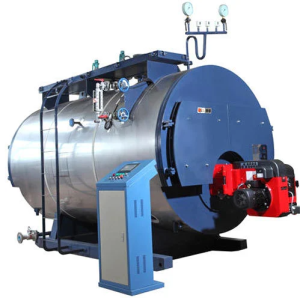
Hot Water Boiler Capacity Factors
- Circulation medium (water or glycol mixture)
- Working pressure
- Fuel input
- Load curve and temperature limits
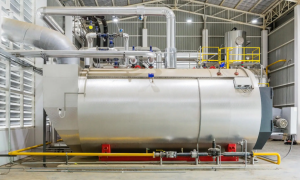
The Risks of Improper Boiler Sizing
Problems With Oversized Boilers
- Excessive fuel consumption leading to budget overruns
- Increased thermal fatigue on system components
- Reduced efficiency from constant cycling
- Higher maintenance and labor requirements
- Generation of more heat than the system can effectively use
Problems With Undersized Boilers
- Inability to meet production demands
- Requirement for extended operating shifts
- Risk of catastrophic failure from overloading
- Premature need for replacement
Units for Measuring Boiler Capacity
Boiler Horsepower (BHp)
The capacity of a boiler to generate steam from water. Defined as the thermal energy required to convert 34.5 pounds (15.6 kg) of water into steam at 212°F (100°C) in one hour.
lbs of steam ÷ 34.5 = BHp
BTU/Hour
British Thermal Unit – measures heat energy. One BTU raises one pound of water by 1°F. Industrial boilers typically require capacities above 135,000 BTU/h.
Specific Heat
The amount of heat required to raise a material’s temperature. Crucial for understanding fuel performance in boiler operations.
Specific Gravity
The ratio of a material’s density to that of a reference substance (usually water). Helps evaluate fuel properties.
Density
Mass per unit volume. Understanding fuel density helps estimate boiler capacity requirements.
Delta T (ΔT)
The temperature difference in a system. Critical for heat dissipation calculations and system safety.
Gallons Per Minute (GPM)
Measures liquid flow rate. Essential for determining production capacity requirements.
Boiler Capacity Calculators
1. Boiler Horsepower Calculator
Converts steam loads (lbs/hour) into boiler horsepower. Simply input your steam load and the calculator divides by 34.5 to determine the required thermal energy at 212°F.
2. BTU/HR to Boiler Horsepower Calculator
Works for both steam and hot water boilers. Converts heat transfer input to BHp by dividing BTU/h by 33,475 (the amount of steam produced by one boiler horsepower).
3. Boiler BTU Calculator (Given Flow and ΔT)
Calculates boiler capacity based on liquid flow and temperature change. Requires inputs of GPM, ΔT, specific heat, specific gravity, and density values.
Conclusion
Accurate industrial boiler capacity calculation is essential for meeting production demands, optimizing efficiency, and protecting your investment. This guide has provided the key concepts and calculation methods to help you determine your perfect boiler size.
For professional assistance in selecting and sizing your industrial boiler system, contact our engineering team today.